Physical Address
304 North Cardinal St.
Dorchester Center, MA 02124
Physical Address
304 North Cardinal St.
Dorchester Center, MA 02124


The institutional money is moving. ✅
On November 21, 2025, CME Group shattered all previous records with 794,903 Bitcoin futures contracts traded in a single day. That's $13.2 billion in notional value flowing through the most sophisticated trading infrastructure on the planet. 🚀
But here's what they don't tell you: These record volumes aren't just random buying and selling. Professional traders are using specific technical analysis strategies that most retail traders have never even heard of.
You're about to discover exactly what they're doing. 💎
While retail traders chase Bollinger Bands and RSI divergences, institutional players focus on something completely different: volume profile analysis combined with CME gap theory.
Here's the reality check you need: ✅
The secret isn't just about price action. It's about understanding where the real money is positioning itself. 🎯

Professional CME traders don't just look at candlesticks. They analyze Point of Control (POC) levels where the highest volume traded during specific periods.
Here's how you'll use this like a pro: ⭐️
✅ Identify Value Areas: 68% of volume clusters around fair value zones
✅ Spot Institutional Support/Resistance: Where big money actually accumulates
✅ Time Your Entries: Wait for price to test POC levels before entering
✅ Set Precise Targets: Use volume gaps as profit-taking zones
The November 2025 volume spike revealed something massive: Institutions were accumulating between $98,000-$102,000 before the final push to $126,000. That $98K level? Pure institutional accumulation zone that retail traders completely missed. 💰
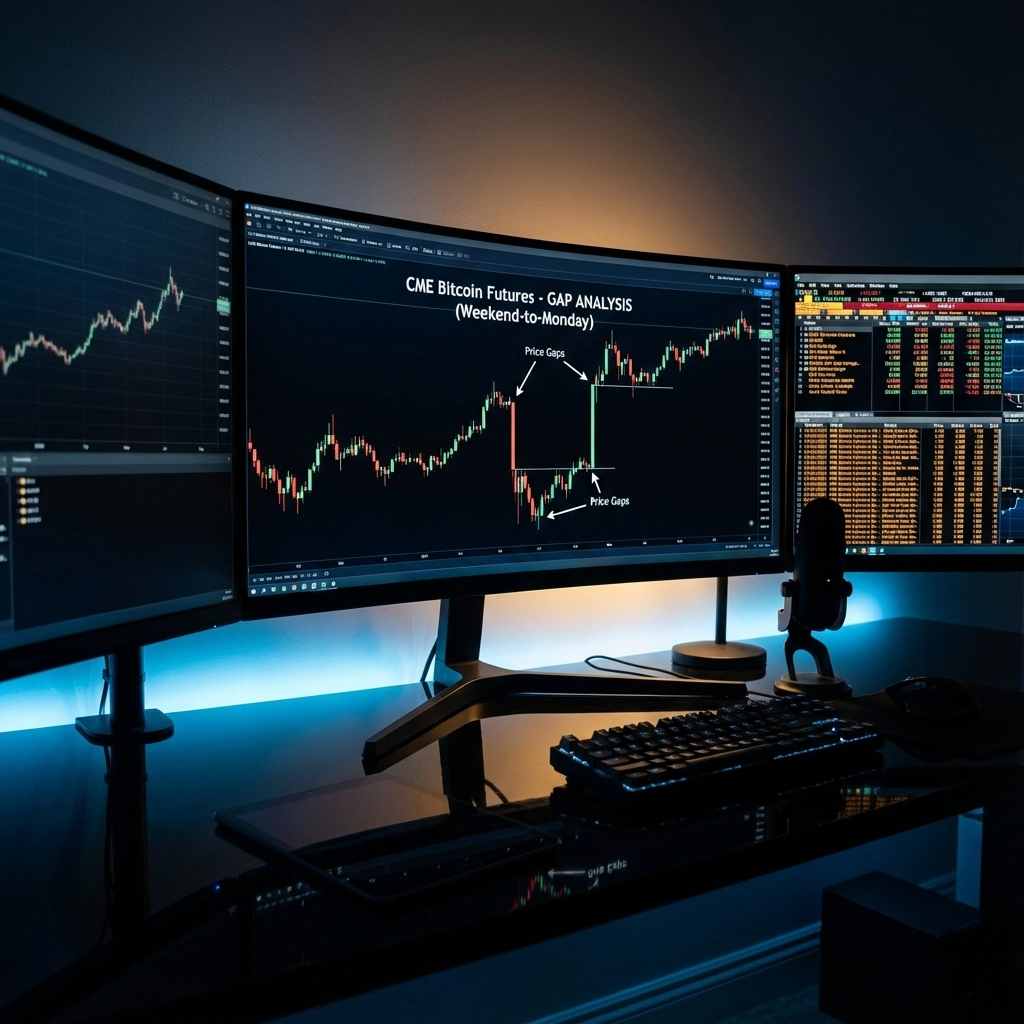
Here's what separates the pros from everyone else: They trade CME gaps with surgical precision.
The institutional playbook works like this: 🚀
Gap Up Scenarios:
Gap Down Opportunities:
Real example from December 2025: Bitcoin gapped down $3,200 on Sunday open, filled the gap by Tuesday, then continued higher for another $8,000 move. Professional traders banked both the gap fill AND the continuation. 📈
July 2025 changed everything. The GENIUS Act removed compliance barriers for traditional financial institutions, and you can see it in the numbers:
✅ Open interest jumped to $31.3 billion in Q3
✅ Daily volume increased 78% year-over-year
✅ Institutional hedging replaced retail speculation
What this means for your trading: Professional money flows create more predictable technical patterns. When institutions hedge $10 billion positions, they leave massive technical footprints you can follow. 🎯
The real secret sauce: CME traders use order flow analysis to see what institutions are actually doing, not just what price is showing.
Here's your institutional reading system: 💎
Bullish Institutional Signals:
Bearish Professional Positioning:
The November record volume day showed classic institutional accumulation: Price consolidated while volume exploded. They were loading up while retail traders got shaken out by sideways action. 🚀

Professional traders spotted something retail missed: Bitcoin's 2025 rally showed a beta coefficient of 2.5-3.0 relative to traditional markets.
Translation: For every 1% traditional market move, Bitcoin moved 2.5-3%. This wasn't organic adoption: it was leveraged institutional positioning responding to liquidity expansion.
Your tactical advantage: ✅
Here's what volume data revealed about institutional timing: ⭐️
Peak Institutional Activity:
Your execution window: Trade these sessions with institutional flow, avoid low-volume periods when spreads widen and manipulation increases. 💰
Institutional risk management isn't about stop losses. It's about position scaling and hedging strategies.
Professional Protection System: 🛡️
✅ Scale into positions over multiple time frames
✅ Use options hedging for downside protection
✅ Diversify across crypto assets (not just Bitcoin)
✅ Maintain cash reserves for opportunity deployment
✅ Monitor correlation breakdown signals
The reality check: When you're managing $100 million, you can't just "set a stop loss and hope." You need systematic risk management that works in all market conditions.

Now you know what the pros actually do. Here's how you'll implement their strategies: 🚀
Step 1: Volume Profile Setup
Step 2: CME Gap Monitoring
Step 3: Order Flow Integration
Step 4: Correlation Analysis
The institutional edge isn't about secret indicators. It's about understanding how real money moves and positioning yourself accordingly. 💎
📚 New to trading or want a structured roadmap?
Check out the Crypto Futures Mastery Course — designed to help traders master risk management, execution, and psychology.
These aren't theories; they're the actual strategies driving $85.7 trillion in annual crypto derivatives volume. ✅
Master these techniques, and you'll never trade like retail again. 🎯